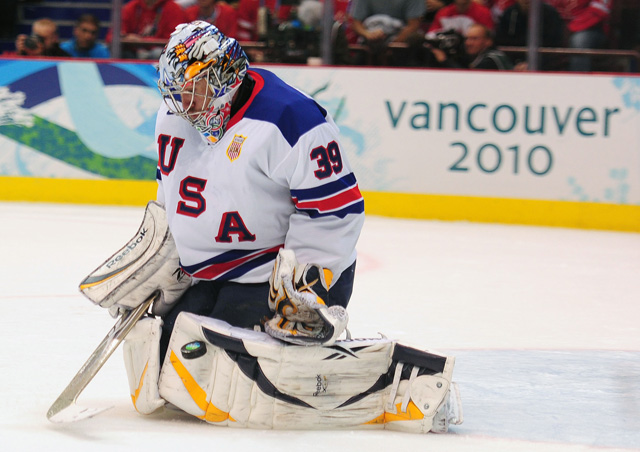
Ryan Miller makes one of his 42 saves against Canada in 2010 prelim game. (USATSI)
With the Olympics less than a month away, United States of Hockey will profile a member of the 2014 U.S. Olympic Men’s Ice Hockey Team almost daily between now and opening ceremonies. Since we’re conditioned as hockey fans to think of these players within an NHL context, this feature takes a longer look at how each player’s skill set and experience translates to the Olympics and the bigger ice surface. Each profile also includes a look back at each player’s national team career and memorable moments or accomplishments while wearing the USA crest.
Ryan Miller – Buffalo Sabres
Hometown: East Lansing, Mich. Development Path: Soo Indians (NAHL) to Michigan State University
Season Stats: 32 GP, 12-18-2, 2.59 GAA, .927 SV%, 0 SO NHL Career Stats: 532 GP, 281-182-1-55, 2.59 GAA, .916 SV%, 28 SO
IIHF Events (finish): 2010 Olympics (silver), 2003 World Championship (13th), 2002 World Championship (7th), 2001 World Championship* (4th) Team USA Career Stats: 14 GP, 9-3-1, 1.76 GAA, .936 SV%, 2 SO Olympic Career Stats: 6 GP, 5-1-0, 1.35 GAA, .946 SV%, 1 SO
*- On roster, but did not play
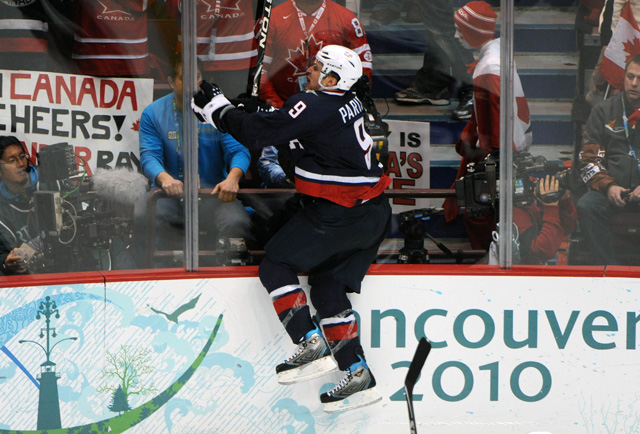
Zach Parise celebrates his game-tying goal in the gold-medal game in 2010. (USATSI)
With the Olympics less than a month away, United States of Hockey will profile a member of the 2014 U.S. Olympic Men’s Ice Hockey Team almost daily between now and opening ceremonies. Since we’re conditioned as hockey fans to think of these players within an NHL context, this feature takes a longer look at how each player’s skill set and experience translates to the Olympics and the bigger ice surface. Each profile also includes a look back at each player’s national team career and memorable moments or accomplishments while wearing the USA crest.
Zach Parise – Minnesota Wild
Hometown: Minneapolis, Minn. Development Path: Shattuck-St. Mary’s (Minn.) to University of North Dakota
Season Stats: 37 GP, 15-12–27, 18 PIM NHL Career Stats: 587 GP, 227-248–475, 211 PIM
IIHF Events (finish): 2010 Olympics (silver), 2008 World Championship (6th), 2007 World Championship* (7th), 2005 World Championship (6th), 2004 World Junior Championship (gold), 2003 World Junior Championship (4th), 2002 World Under-18 Championship (gold) Team USA Career Stats: 38 GP, 25-22–47, 18 PIM Olympic Career Stats: 6 GP, 4-4–8, 0 PIM * – Played one game
After taking a look at the U.S. National Junior Team as a whole and detailing the play of the forwards, it’s time to close the book on the 2014 World Juniors with the final looks at Team USA’s defense and goaltending. After coverage that dates back to June when the initial summer evaluation camp roster was named, this is the last piece on the tournament.
Photo: Ellen DeLuca/USA Hockey
It’s always bittersweet when the coverage of one tournament ends, but with the Olympics on the horizon, there is plenty to look forward to in international hockey.
When it came to the 2014 U.S. National Junior Team, they had to find a way to make up for the losses of three defensemen from last year’s team that were eligible to return. Guys like Jacob Trouba and Seth Jones, currently plying their trade in the NHL, are irreplaceable. Meanwhile, Patrick Sieloff, still recovering from a staph infection, would have brought some great leadership and solid shutdown minutes to the roster.
Team USA counteracted those significant losses by building a very balanced defense corps that allowed for versatility in the lineup and had enough talent to roll the pairings throughout the tournament regardless of opponent.
The goaltending was an expected strength for Team USA coming into the tournament with Jon Gillies and Anthony Stolarz the top goaltenders in their respective leagues. Gillies ended up taking the reins and was dealt a mix of bad luck and allowed a few ill-timed rebounds that blemished his tournament a bit. Even with a few miscues, it’s hard to hang the early exit on goaltending.
Coming up after the jump, a look at Team USA’s defense and goaltending. Continue reading →
After taking a look at the team as a whole and examining how everything happened and what we can learn from it, there’s a far simpler task ahead. It’s time to look at how the individuals performed under the bright lights of the World Junior Championship.
Photo: Ellen DeLuca/USA Hockey
When you take a look at the whole group, it can sometimes be hard to pinpoint where the failures or successes were as so much needs to be accomplished as a group to have success in a short tournament. Looking at the individual tells some of that story as well, but a player either had a good tournament or he didn’t. You can also see the elements in a player’s game that will translate well in future tournaments or in that player’s career.
The one thing I always try to caution people about is judging a player in the big picture based on the painfully small sample size of a tournament like the World Junior Championship. This U.S. team via an early exit only played five games. It’s hard to tell a big story in a five-game sample. So if a player didn’t perform well or struggled at this tournament in some capacity, it’s not necessarily an indication of what that player is as a prospect and where he may be going.
So with that in mind, I’ll keep the focus mainly on the tournament, but with other viewings in mind I’ll add some thoughts here and there about the bigger picture as well. Here’s a look at Team USA’s 13 forwards.
The U.S. National Junior Team saw their World Junior Championship come to an end far sooner than they could have expected it to in 2014. After starting with three sound wins over weaker opponents, the U.S. suffered back-to-back losses to their biggest international rivals with Canada taking the final prelim game and Russia eliminating the U.S. in the quarterfinals. In the end, USA finished the 2014 World Junior Championship in a fifth place.
Finland won the gold medal Sunday, beating rival Sweden 3-2 in overtime. Buffalo Sabres prospect Rasmus Ristolainen scored the golden goal to make Finland the fifth different gold medalist at the WJC since 2009. That means Finland will be in the same group with USA and Canada at next year’s World Junior Championship.
The optics of an early exit are never good. However, it seems this time around, there’s not really much need for outrage. Is it disappointing coming off the gold medal? Of course. This team should have done better, but I don’t see this team as a dramatic underachiever even finishing outside the medal round.
It is a far cry from the seventh-place finish by the 2012 team, that by any measure, was far better on paper than the one USA Hockey sent in 2014. Even with that in mind though, U.S. teams absolutely should have the depth to be a gold-medal contender every time they enter a tournament and I think even this year’s team was. Once you get to single elimination, however, anything could happen. Continue reading →
The U.S. played with fire too much and got burned. Now their World Junior Championship is over. Team USA fell to Russia 5-3 in the quarterfinals in Malmo today. A pair of 5-on-3 power-play goals in the second period made up the difference and put the U.S. on their heels for the final half of the game. Team USA’s final placement won’t be decided until the quarterfinal ends, but it will be no higher than fifth.
It is a disappointing result for a team that started the tournament 3-0-0-0. The sting for the Americans only intensifies as losing back-to-back games to their biggest international rivals cost them the tournament.
When it came down to it, Team USA made too many mistakes with penalties and didn’t have enough of a response when the game got tougher to have earned the right to advance. It wasn’t a dreadful effort against Russia, as Team USA led going into the second period 3-2, but it certainly was not good enough at this level.
The thing about short tournaments is that it doesn’t take much to flip a game or a tournament on its head. For the U.S., they couldn’t respond well enough when things weren’t going their way. That goes back to the prelim loss against Canada and now the elimination at the hands of Russia. A lot of players played well, but there just wasn’t enough from the group as a whole to get over the hump.
Coming off the gold medal last year, there was pressure on this team, but there was a large difference between last year’s squad and this one. The depth of talent wasn’t there, but the way this team was built, they had an opportunity to make some noise in the tournament. Unfortunately for the U.S., they came up short and weren’t able to prove they had the depth to overcome the players they lost this year to the NHL or injury.
Happy New Year, everyone! Now the real fun begins at the 2014 IIHF World Junior Championship. From here on out, it’s win or watch your tournament end. The U.S. National Junior Team will meet Russia in the quarterfinals at 6 a.m. ET. The game will be carried live on NHL Network with a free live stream on NHL.com for fans in the U.S.
The U.S. faces a tough road if they want to repeat as gold medalists at the World Junior Championship. Running into Russia in the quarterfinal is certainly a difficult draw coming off of the disappointing 3-2 loss to Canada in the preliminary round.
Russia presents a unique challenge to the U.S. as a highly-skilled team with an excellent goaltender between the pipes. Russia’s defense is only OK, but as a team they’ve had some solid games in the tournament. A 3-2 loss to Sweden and stunning 4-1 loss to Finland is how the Russians ended up in third place.
It’s not as well known as the USA-Canada rivalry, but at the U20 level and below, USA-Russia is a very solid rivalry in its own right. These players have gone head-to-head since they were about 16 and there have been some classic match-ups between the two sides. Notably, the Russians beat Team USA 2-1 last year at the World Juniors, putting the U.S. in a tough spot. This game is going to be unpredictable and probably very close to the end. It should be a great quarterfinal in the most evenly-matched of the games in the opening stage of the medal round.
Team USA Update
The U.S. has to quickly shake off the sting of losing to Canada and get ready to go against a very good Russian team. The U.S. didn’t play altogether poorly against Canada, but they struggled in the latter half of the second period and early in the third, which put them in a hole. They can’t afford the same fate against Russia with big Andrei Vasilevski in net.
The U.S. once again should have all hands on deck heading into the game with its full lineup. The bench got shortened up quite a bit late in the game. The U.S. hasn’t had too many other instances where they weren’t getting four lines rolling consistently. They will need the whole lineup against a speedy, skilled Russian squad.
This will also be the earliest game the U.S. has played at the WJC this year, in terms of time of day. The noon local time start is not ideal for either team. Those early games sometimes take a while to get settled down as the routine for the players gets muddied a bit. A team that gets off to a quick start could have an advantage in the game.
Team USA is the least penalized team coming into the playoff round, but they’ve had some costly ones in terms of when they happened. Team USA has 36 minutes in penalties, all of which have come on minors. That type of discipline will matter against Russia, which has a great power play.
This game is obviously huge for both teams. Anytime you’re in an elimination game, everything gets tighter. The nerves get going and there can be mistakes for some players. For others, the intensity of the situation sharpens them. Where will the U.S. fall on that scale? Well, there are a lot of guys who have played in this situation in other tournaments and have had some success. That certainly helps heading into Thursday.
The U.S. hasn’t met Russia in the playoff round in some time at the World Junior Championship, but have an 0-4 record in elimination games against Russia. So the history isn’t favorable, but the U.S. has been a lot better at this tournament in recent years. The U.S. has won six of their last seven trips to the quarterfinals.
About Russia
Russia finished group play with a somewhat surprising 2-0-0-2 record. They rolled over Switzerland and Norway with relative ease, but ran into a pair of hot goalies in Sweden and Finland respectively.
The team’s most important player in this and any game for Russia is goaltender Andrei Vasilevski. The Tampa Bay Lightning first-round pick has been excellent in the KHL this year and is in his third World Junior Championship. He has great size and the experience certainly counts for something. He sat in the 4-1 loss to Finland, which ended up being a bad decision, and then played very well in a tough loss to Sweden.
Up front, the Russians have a lot of high-end skill led by their top line of Mikhail Grigorenko, Anton Slepyshev and Pavel Buchnevich. Other guys that can really make things happen include Bogdan Yakimov and Ivan Barbashev. If you give any of Russia’s forwards time and space, they can make you pay. As a team, they have a lot of guys that can finish the chances they’re given. That is especially true on the power play.
Russia has scored on eight of 17 advantages in the tournament, which is good for second behind the U.S. They are good at drawing penalties with their skill and essentially live off their power play in tougher games.
The defense is OK for Russia. They won’t wow you and they could get overwhelmed by Team USA’s speed. Nikita Zadorov, who spent time with the Sabres this year, is a high-end player on the back end though, so having a guy like him makes them a bit tougher on the back end.
Here’s a look at the highlights from Russia’s last game against Sweden.
Stay Smart — If the U.S. starts taking penalties in this game and lets Russia’s power play work their magic, it’s going to be bad news for the Americans. They should be the better team 5v5 against most of Russia’s lineup, so avoiding penalty trouble and not giving Russia anything cheap is going to be a big key. Team USA got sunk by third-period penalties against Canada and will probably have learned from those mistakes. Staying disciplined and letting their speed do the work instead of their sticks will be important.
Own the Middle — This Russian team does very well when they get looks at the net. If the U.S. can control the middle of the ice in their own zone, they’ll limit chances and keep the Russians to the outside where it will be tougher to score. The U.S. has to have a presence at the net front at the other end as well. Allowing Vasilevski clean looks at the puck is going to make him tough to put it past. The U.S. has too many strong forwards up front not to be getting to the net and making things difficult. Being the better team between the dots will lead to success.
Battle — This has a couple of meanings. The first is that the U.S. should be able to win a lot of the battles in the game. Puck battles along the boards and at the net front should be where the U.S. is often the better team. They’re too strong for Russia to push them around, so they have to be ready to go there. The second meaning is that the U.S. has to keep its battle level up for 60 minutes. The Americans were dominant against Canada early and when Canada pushed back, the U.S. didn’t respond emphatically enough. The U.S. has to be the more competitive team with their backs against the wall. Settling nerves and doing the work right away will make this U.S. squad tough to beat.
Quarterfinal Schedule
All games will air live on NHL Network Thursday. USA-Russia will also simultaneously stream live on NHL.com. All Times Eastern
USA vs. Russia — 6 a.m.
Finland vs. Czech Republic — 8:30 a.m.
Canada vs. Switzerland — 11 a.m.
Sweden vs. Slovakia — 1:30 p.m.
LINKS
– USA Hockey’s official game notes for the quarterfinal matchup (USAHockey.com)
– Tournament scoring leaders include Anthony Mantha of Canada and Slovakia’s Martin Reway and David Griger, who all have 10 points. (PDF via IIHF.com)
– USA leads the tournament in power-play efficiency with a 50 percent success rate (11-for-22). Here are other team stats. (PDF via IIHF.com)
– Team USA has five Illinois natives on the roster, showing growth of the game in the state and a sign of where it is going in the future. (USAHockey.com)
The game certainly lived up to the hype as USA and Canada played another one-goal game on New Year’s Eve. Canada earned the 3-2 win thanks to a strong second half of the game after the U.S. clearly dominated the first portion of it. The loss puts Team USA in second place in Group A, setting up a quarterfinal date on Jan. 2 with rival Russia at 6 a.m. ET.
It was another exciting game in the USA-Canada World Junior series, but Canada has been near impossible for the Americans to beat in the preliminary round for some reason. The U.S. remains winless in the prelims since 1998 over their North American rival. The sting intensifies a little as the road to the gold medal gets a heck of a lot tougher by losing the group after needing just one standings point to clinch it.
The U.S. path to gold definitely includes Russia, almost certainly Sweden in the semifinals and if Canada makes it, a date with the Canadians in the gold medal game. They have to beat Russia first of course, which will be no easy task. If they don’t, their tournament is over far sooner than even they could have anticipated.
So the real tournament starts now. The U.S. gets a dose of adversity heading into the playoff round, but there were enough positives to be taken out of the loss to Canada for Team USA to go into the next stage with some confidence. You never want to lose to your biggest rival, especially to lose the group, but there was a lot to be learned about this U.S. team today.
This is the match-up you hope to see in every World Junior Championship. The history between the two rivals, particularly in the last decade has made this must-see TV for any hockey fan. You never know how it’s going to turn out, but when the U.S. plays Canada, you know it is going to be as exciting and intense as any game you can see. NHL Network will air the game live, with a simultaneous free live stream on NHL.com in the U.S. at 11:30 a.m. ET.
The game also takes on a rather significant tone as the winner of the USA-Canada game will take the top seed in Group A heading into the medal round, with a few different scenarios altering the outcome. A win of any kind gives the U.S. the group. If Canada beats the U.S. in regulation, they win the group outright. However, if the game does not conclude in regulation, the U.S. will win the group regardless of result. An overtime or shootout win is only two points, while the loser gets the remaining point. In an overtime/shootout loss situation, the U.S. would beat Canada by one point to win the group, finishing with 10 points over Canada’s nine. So… there’s your education in the three-point system.
The loser would likely have to play Russia in the quarterfinal, which is a pretty tough draw that early in the playoffs. That of course is if Sweden beats Russia, which they are favored to do, but anything can happen. Another scenario would have the loser play Finland in the quarterfinals and a highly unlikely chance of meeting Sweden. So, craziness on the last day at the WJC could change plenty.
This game almost didn’t have the significance it now carries as Canada trailed Slovakia almost the whole way until a third-period outburst turned the tide. A loss of any kind for Canada would have sealed the group for the U.S. If you ask me, I much prefer a USA-Canada game when there’s something to play for. This should be a fun one.
As with any USA-Canada game, expect the unexpected. It always seems something crazy happens with how emotional this game becomes and how much of a New Year’s Eve tradition it has become. Canada has plodded through the tournament so far, while the U.S. has cruised. It could be an interesting 60 minutes (or more) of hockey.
Games like Sunday’s are always tough. The U.S. knew it was going to roll over Germany, and of course they did, winning 8-0. Team USA is now 3-0-0-0 and is guaranteed to head into Tuesday’s game against Canada as the first place team in Group A. The U.S. has outscored its opponents 19-4 in WJC action so far.
Heading into the day off before meeting Canada, it’s good to get into a scoring rhythm and keep the confidence level high, but there wasn’t much competitiveness or intensity in Sunday’s contest. Now Team USA gets an extra day to prepare for the highly anticipated New Year’s Eve game. That one could have some real interesting implications for the medal round, depending on what Canada does against Slovakia on Monday.
Getting back to the game against Germany, Team USA did a lot of things well, most notably on the power play where they were just scoring at will. Their 5v5 play was better as well, but with all the German penalties, they didn’t have as much time as they probably would have liked.
This U.S. team has shown a lot more skill than I thought they had and the way the lineup is structured, they’re built for success.










 The United States of Hockey